
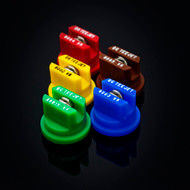
How to Test Spray Nozzle Tips for Wear and Know When to Replace Them
Posted by Sprayer Supplies Team on 27th Apr 2026
Nozzle tips are among the cheapest components on a sprayer. A replacement set of tips for a 30-foot boom costs less than an hour of custom application rates. Yet worn nozzles running 15–20% over rated output represent the same error as miscalibrating your entire sprayer: you are over-applying product on every acre while believing your rates are correct.
The challenge is that nozzle wear is invisible. You cannot see gradual orifice enlargement by looking at the tip. The only way to detect worn nozzles is to measure their output. Here is exactly how to do it and what to do with the results.
What Nozzle Wear Actually Does to Your Application
As a nozzle tip wears, the orifice enlarges. The consequences are specific and compounding:
Flow rate increases. A 10% worn nozzle delivers 10% more chemical per acre than you are paying for and intending to apply
Droplet size increases. A larger orifice at the same pressure produces larger droplets, which may move the application outside the pesticide label droplet size specification
Pattern uniformity degrades. Irregular orifice wear produces asymmetric fan patterns, creating strips of over- and under-application across the boom
On positive-displacement pump systems, pressure drops as worn orifices allow more flow. A worn nozzle boom can show false low-pressure readings that mask the wear from a rate controller
When nozzles wear unevenly, some worn, some new, the boom creates a striped application pattern. Herbicide-resistant weed escapes in under-applied strips and chemically burned areas in over-applied strips can both result from the same boom on the same pass.
The Industry Standard: The 10% Rule
The agriculture industry standard for nozzle replacement is to replace any tip that delivers more than 10% above its rated flow at the manufacturer's tested pressure (typically 40 PSI for flat fan nozzles). Some precision applicators use a stricter 5% threshold.
What the 10% rule means in practice: a nozzle rated at 0.20 GPM should be replaced when it delivers 0.22 GPM or more at 40 PSI. A nozzle rated at 0.40 GPM should be replaced at 0.44 GPM or more.
If the majority of nozzles on the boom have reached this threshold, replace the entire set together. Mixed worn and new nozzles create inconsistent application across the boom. Replacing the worst offenders while leaving the others produces a temporarily uneven boom that will require another replacement cycle shortly.
How to Test Nozzle Output: Three Methods
Method 1: The Measuring Jar and Timer (Minimum Equipment)
The classic approach requires only a measuring jar graduated in ounces or milliliters and a stopwatch:
Fill the sprayer with clean water and pressurize to the nozzle manufacturer rated test pressure (40 PSI for most flat fan nozzles. Check the nozzle catalog.)
Hold the measuring jar under a single nozzle and collect output for exactly 30 seconds
Multiply the collected volume by 2 to get ounces per minute (OPM), then divide by 128 to convert to GPM
Compare to the rated GPM at 40 PSI from the nozzle catalog
Repeat for every nozzle on the boom. Any tip more than 10% above rated output is worn. Any tip more than 10% below is plugged or partially blocked
The limitation of this method is that holding a jar under a nozzle for 30 seconds is slow and somewhat imprecise, particularly if the nozzle is producing foam from residual chemical or poor rinsing. Test with clean water after thoroughly flushing.
Method 2: Digital Nozzle Calibrator
Digital nozzle calibrators, also called SpotOn calibrators, are flow meters specifically designed for nozzle testing. You hold the calibrator under the nozzle, it measures flow and displays GPM or OPM with a readout indicating whether the tip is within specification. Most digital calibrators indicate pass or fail based on the 10% industry standard automatically.
These tools are significantly faster than the jar method, particularly when testing all nozzles on a long boom. For operations that regularly test tips at the beginning of each season, a digital calibrator pays for itself in time savings within the first use. For a 60-nozzle boom, the jar method takes over an hour. A digital calibrator can complete the same test in about 20 minutes.
Method 3: Pattern Board Inspection
Visual pattern inspection using water-sensitive paper or a flat surface does not measure flow rate directly, but reveals pattern degradation, asymmetric fans, double peaks and gaps that indicate orifice damage. This method supplements flow rate testing but does not replace it. A nozzle can deliver correct flow with a degraded pattern. Flow testing alone will not catch pattern problems.
To test, spray clean water onto a flat, dark surface or pattern board placed at operating boom height. Inspect each nozzle's pattern individually. A healthy flat fan nozzle produces a symmetric, evenly tapered fan with no double streaks, gaps or heavy edges.
How Long Nozzle Tips Actually Last: Material Comparison
The nozzle material selected should match the application. Running ceramic nozzles for general herbicide application is unnecessary cost. Running polymer nozzles with abrasive wettable powder products accelerates wear and shortens the replacement cycle. Match material to chemistry and application frequency.
Building a Nozzle Testing Schedule
Pre-season: Test every tip before the first application of the year. Replace any that fail the 10% test. Document which tips were replaced and their hours at replacement.
Mid-season check: After the first major application program (pre-emergent season), re-test nozzles before switching to post-emergent or fungicide programs. Different programs often require different nozzle configurations. This is a natural inspection point.
When changing tip types: Any time tips are swapped for a different application, moving from herbicide to fungicide to fertilizer, inspect all tips before returning them to the boom.
After any abrasive product application: Wettable powder formulations, some micronutrient suspensions and products with physical abrasives accelerate tip wear. Test immediately after these applications.
Nozzle Wear and Testing: Practical Q&A
Q: How do I know if my spray nozzle is worn out?
A: You cannot determine nozzle wear by visual inspection alone. The only reliable method is to measure output at the manufacturer’s rated pressure and compare it to the rated flow. If the nozzle delivers more than 10% above its rated flow, it is considered worn and should be replaced.
Q: What happens if I keep using worn spray nozzles?
A: Worn nozzles increase flow rate, which leads to over-application of chemical per acre. This raises input costs, increases the risk of crop injury and can move the application outside pesticide label requirements. Uneven wear across the boom can also create striped application patterns with both over- and under-treated areas.
Q: Is it better to replace one worn nozzle or the entire set?
A: If only one or two nozzles fail the 10% test, those individual tips can be replaced. However, if multiple nozzles across the boom exceed the wear threshold, replacing the entire set is recommended to maintain consistent flow and pattern uniformity.
Q: How often should spray nozzles be tested?
A: At minimum, test nozzles before the first application of the season. Additional testing is recommended mid-season, after applying abrasive products and any time nozzle types are changed for a different application program.
Q: What pressure should I use when testing spray nozzles?
A: Always test at the manufacturer’s rated pressure for that nozzle. For most agricultural flat fan nozzles, this is typically 40 PSI, but the exact value should be confirmed in the nozzle catalog.
Q: Can a nozzle be plugged even if pressure looks normal?
A: Yes. A partially plugged nozzle may reduce flow without significantly changing system pressure. Measuring output is the only way to detect under-performing or restricted nozzles.
Q: Does nozzle material really affect wear life?
A: Yes. Material selection has a direct impact on durability. Polymer nozzles are economical and suitable for general herbicide use, while stainless steel and ceramic provide significantly longer service life in high-acreage or abrasive applications.
Q: Do larger droplets from worn nozzles reduce drift risk?
A: Not necessarily. While larger droplets can reduce drift potential, worn nozzles also distort spray patterns and increase application rate. This can lead to uneven coverage, reduced efficacy and regulatory compliance issues.
Frequently Asked Questions (FAQ): Nozzle Wear and Replacement
How much wear is acceptable in a spray nozzle?
Up to 10% above rated flow is the industry replacement threshold. Many precision operations use a stricter 5% limit.
What is the fastest way to test spray nozzles?
A digital nozzle calibrator provides the fastest and most consistent results, especially on large booms.
Can I mix new and used nozzles on the same boom?
Mixing new and worn nozzles is not recommended because it creates inconsistent application rates across the boom.
What causes spray nozzles to wear out faster?
Abrasive products such as wettable powders, suspension fertilizers, high pressures and high-acreage use accelerate wear.
Do ceramic spray nozzles last longer than stainless steel?
Yes. Ceramic nozzles typically provide the longest service life and are often used in high-acreage or precision applications.
Should I test nozzles with chemical in the tank?
No. Always test using clean water after thoroughly flushing the system to ensure accurate measurements.
What is the most common mistake when testing spray nozzles?
Testing at the wrong pressure or failing to compare results to the manufacturer’s rated flow specification.
How long does it take to test all nozzles on a boom?
Using a measuring jar method, testing can take over an hour on a large boom. A digital calibrator can reduce that time significantly.
Shop Replacement Nozzle Tips at Sprayer Supplies
Sprayer Supplies stocks TeeJet Nozzles, Hypro Nozzles and Greenleaf Nozzles nozzle tips in all standard sizes and materials. Browse the full lineup at sprayersupplies.com/sprayer-nozzles or call (844) 328-9900 for help matching replacement tips to your application and boom configuration. Tips are available in individual packs and full boom sets.