
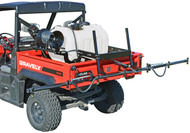
ATV vs. UTV Sprayer: Which Is Right for You?
Posted by Sprayer Supplies Team on 15th May 2026
ATV vs. UTV Sprayer: Which Is Right for You?
Published by the Sprayer Supplies Team
If you're in the market for a new sprayer and you run your operation on an ATV or UTV, you've probably already realized the question isn't just "what size tank do I need?" It's a bigger one: should I be building my spraying setup around an ATV or a UTV in the first place?
These two platforms feel similar on the surface — both are off-road vehicles, both can carry a mounted sprayer, and both let you cover ground that a tractor or truck can't easily reach. But the differences between them matter enormously when you're talking about practical performance, comfort, cost, cargo capacity, and what you can realistically accomplish in a day's work.
This guide breaks it all down. We'll walk through how ATV and UTV sprayers actually differ, what each platform does best, the specific scenarios where one clearly wins over the other, and how to match your sprayer configuration to whichever platform you choose. By the end, you'll have a clear answer — or at least a clear framework — for which setup fits your land, your operation, and your budget.
First, Let's Define the Platforms
Before getting into sprayer specifics, it helps to get grounding on what we mean by each vehicle type, because the terms get misused often enough to cause real confusion.
ATVs (All-Terrain Vehicles) — also called four-wheelers or quads — are single-rider vehicles straddled like a motorcycle. The rider sits on a seat centered over the machine, steers with handlebars, and operates the throttle and brakes by hand. Most ATVs have a rear cargo rack and, on some models, a front rack as well. They're generally lightweight, narrow, and highly maneuverable. Engine displacement typically runs from 400cc to 700cc or more on performance models, and payload capacity on the racks usually falls somewhere between 100 and 200 pounds front and rear combined, though this varies significantly by make and model.
UTVs (Utility Task Vehicles) — also called side-by-sides — are a different class of machine entirely. They have a cab structure with a steering wheel, bucket or bench seats, and often a roll cage. Most UTVs accommodate two to six passengers side by side, hence the nickname. They're wider, heavier, and built with higher cargo-hauling ambitions. The cargo bed in the back of a UTV is the key feature for sprayer setups: it functions much like a small truck bed, capable of carrying 500 to 1,000+ pounds depending on the model. Engine sizes range from around 400cc on entry-level models to over 1,000cc on workhorse UTVs from brands like Polaris, Can-Am, and John Deere.
The result is two very different vehicles that each attract sprayer setups but serve distinctly different purposes.
The Core Differences That Matter for Spraying
Tank Size and Weight Capacity
This is usually the first place people feel the difference, and it's significant.
On an ATV, you're working within tight constraints. The rack system — typically bolted to the front and rear of the machine — is the only real estate you have, and it isn't much. Most ATV sprayers top out around 25 to 40 gallons before weight becomes a genuine concern. A gallon of water weighs about 8.3 pounds, so a full 25-gallon tank is already over 200 pounds before you account for the sprayer frame, pump, hoses, and hardware. Load that onto the rear rack of an ATV and you're right at or past the rated capacity of most machines. Exceeding that limit doesn't just void warranties — it compromises handling, strains the suspension and frame, and turns the machine into something genuinely difficult and potentially dangerous to operate on uneven terrain.
UTVs play by different rules. Because the sprayer sits in a proper cargo bed, weight is distributed much more favorably. A 60-gallon sprayer in a UTV bed weighs roughly 500 pounds full — well within the carrying capacity of most mid-range UTVs, and comfortably handled by larger machines. Many UTV operators run 60 to 100-gallon tanks without issue, and heavy-duty UTVs from John Deere, Polaris Pro XD, or Can-Am Defender can push even higher. More gallons means fewer trips to refill, which translates directly to more acres covered per hour.
If you're spraying a small property — a few acres of food plots, a residential lawn, a fence line, or a small pasture — the ATV's capacity limitation might not matter much. But if you're managing 50, 100, or 500 acres, the difference between a 25-gallon and a 75-gallon tank is the difference between constantly stopping to refill and actually getting the job done.
Vehicle Width and Maneuverability
Here's where the ATV makes a strong argument for itself.
ATVs are narrow — most are 48 inches wide or less. That lets them thread through tight spots that UTVs simply can't reach: dense orchards, narrow fence lanes, hedgerows, tight brush paths, and sections of property where the terrain closes in. If your land has a lot of these chokepoints, the ATV's slim profile becomes a genuine operational advantage.
UTVs, by contrast, are substantially wider. Entry-level models often run 55 to 60 inches, and larger utility UTVs frequently hit 64 to 72 inches or more. On open fields, pastures, and road-accessible land, that extra width is a non-issue. But in tight terrain, it's a real limitation. You may find yourself unable to access certain areas at all, or forced to use a handheld wand instead of boom coverage, which defeats some of the efficiency gains from running a larger rig.
There's also the matter of turning radius. ATVs handle more like motorcycles — they tip, lean, and cut tight turns with agility. A UTV has a longer wheelbase and turns more like a small truck. In an open hayfield, this doesn't matter. In an orchard where you're looping around trees every 15 feet, it matters quite a lot.
Operator Comfort and Fatigue
This is a factor that gets underestimated until you've actually spent a long day on both platforms.
Operating a UTV is dramatically more comfortable than an ATV for extended work. You sit in a proper seat with back support, you steer with a wheel, and you're inside a cab (at least partially) that offers some protection from dust, wind, spray mist, and sun. Many UTVs come with windshields, roofs, and even heating and cooling options. If you're spraying for four or six hours at a stretch, that matters to your body and your focus.
On an ATV, you're leaning forward on a straddled seat with your hands on handlebars and your body constantly compensating for terrain. It's physically demanding work, especially over rough or hilly ground. Many ATV operators also report difficulty operating spray controls simultaneously — running the throttle, watching the boom coverage, and managing a spray wand requires splitting your attention in ways that a UTV's layout makes easier, since you can mount controls to the dash area and operate with one hand.
If your spraying sessions are short — 30 to 60 minutes of spot treatment — the comfort differential is minor. If you're running a full day's application program on a large property, the UTV keeps the operator more effective, longer.
Operator Capacity and Passenger Work
UTVs allow for a second person — a helper who can operate the spray controls, manage the wand, watch for problems, or simply ride along. On larger operations, this cooperative workflow can meaningfully increase the quality and efficiency of the work. A passenger can handle spot-spraying duties manually while the driver maintains consistent forward movement, eliminating the stop-start pattern that reduces coverage consistency.
ATVs are inherently solo machines. That's fine for most individual operators, but it does limit how you can staff and organize a spraying day.
Sprayer Mounting and Configuration
The physical integration of the sprayer with the vehicle differs considerably between the two platforms.
On an ATV, sprayer tanks are typically mounted on the rear cargo rack using a frame designed to bolt into or onto the existing rack. Smaller auxiliary tanks can also go on the front rack. Pumps are usually 12-volt diaphragm units powered off the ATV's battery — reliable, compact, and easy to work with. Boom arms (if used at all) are typically short — 4-foot or 5-foot folding booms that extend from the rear. The whole setup stays fairly compact because it has to.
On a UTV, the sprayer sits in the bed and can be a considerably more robust unit. Larger 12-volt pumps, higher-capacity tanks, longer boom arms (often 10 to 15 feet or more extended), and more elaborate plumbing all fit comfortably. Because the bed has structure on three sides, the sprayer sits securely without needing to be strapped to a rack. This also makes swapping sprayers in and out — or loading a different piece of equipment in the same bed — more practical.
One consideration for UTV setups: if you want to run a boom, the boom arms need to extend beyond the rear of the vehicle and above the cab height enough to avoid obstruction. Many UTV sprayers are configured for boomless operation with wide-angle nozzles, which is effective for broadcast herbicide work but less precise than a flat-fan boom for applications requiring consistent, measured coverage. Planning your boom configuration before you buy is worth the effort.
When an ATV Sprayer Is the Right Choice
With that foundation in place, let's talk about the specific scenarios where an ATV sprayer makes the most sense.
Small to Medium Acreage
If you're managing under 20 to 30 acres of sprayable ground, an ATV sprayer typically covers the need without the overhead of a UTV. You'll refill more often, but refills at smaller scale aren't a significant time sink. Many landowners in this category already own an ATV for other purposes — hunting, trail riding, general property maintenance — and adding a sprayer to an existing machine is an economical way to get spraying capability without a major equipment purchase.
Tight Terrain and Dense Vegetation
Orchards, vineyards, dense food plots, narrow fence lines running through brush, and heavily wooded acreage where paths are tight — these environments favor the ATV's narrow footprint. If your land frequently requires threading through gaps that would stop a wider machine, the ATV isn't just a preference; it may be the only option that gets the job done without clearing new paths.
Spot Treatment Applications
When the primary mission is spot-treating problem weeds, invasive species, or isolated pest pressure — rather than blanket broadcasting across an entire field — the ATV's agility is an asset. You're making frequent, reactive decisions about where to spray rather than following programmed passes. The ATV's quicker handling and faster change-of-direction lets you operate more reactively.
Steeper Terrain
This is a nuanced point: both ATVs and UTVs operate on slopes, and both can be dangerous when overloaded on steep grades. But as a general rule, an ATV's lower center of gravity and narrower footprint can navigate certain steep terrain more safely than a tall-sided UTV loaded with a full tank in the bed. With a UTV, a heavy load in the elevated bed raises the center of gravity in ways that can become unstable on significant slopes. If your land has steep hillsides as a primary spray area, consult the specific ratings for your vehicle, keep tanks as low as possible, and never operate a heavily loaded sprayer above the rated incline capacity of your machine.
Budget-Conscious Entry
ATV sprayers are simply less expensive to buy and operate in most cases. If you already own an ATV, adding a 25-gallon broadcast sprayer with a 12-volt pump can cost a few hundred dollars on the low end and expand from there. Starting from scratch with a UTV is a significantly larger investment. For operations just getting into systematic spraying, or for those with limited budgets, the ATV is often where it makes sense to start.
When a UTV Sprayer Is the Right Choice
Now let's look at the scenarios where a UTV sprayer justifies its additional investment — and in many cases, outperforms the ATV so decisively that there isn't really a comparison.
Larger Acreage Operations
Above about 30 to 40 acres of active spray ground, the UTV's tank capacity starts paying for itself in time saved on refills alone. If you're managing 100 acres of pasture for weed control, running a 75-gallon UTV sprayer rather than a 25-gallon ATV sprayer roughly triples the area you can treat before refilling. Over a full spray day, that's a significant difference in effective coverage — and it's a difference that compounds every time you go out.
Boom Spraying for Broadcast Coverage
If consistent, calibrated broadcast coverage is your goal — applying herbicide at a measured rate across a wide swath — a UTV sprayer with a proper boom arm gives you far better results than the ATV equivalent. Larger boom configurations (10 feet, 15 feet, or more) deliver more even coverage with better nozzle consistency, and the UTV's cargo bed allows for a more stable, properly supported boom mounting system. This is especially important for post-emergent herbicide applications where coverage uniformity directly affects efficacy.
Commercial and Multi-Acre Property Management
Lawn care operators, land management companies, ranchers, and large-acreage landowners consistently gravitate toward UTV-based sprayers because the platform supports a professional-grade setup. Higher-capacity tanks, more robust pumps, proper boom configurations, and better operator ergonomics all add up over the course of a season. If spraying is a regular, systematic part of your operation rather than an occasional chore, the UTV is the better long-term platform.
Multi-Person Operations
If your workflow benefits from having an operator and an assistant — or if multiple people are sharing the machine throughout the day — a UTV makes that collaboration physically possible. This is especially relevant for pest control operators, lawn care teams, and land managers who run crews.
Winter or Inclement Conditions
Many UTVs can be outfitted with windshields, roofs, doors, and heating, making them practical for spraying operations in cold or wet conditions where an ATV would leave the operator exposed. De-icing and winter weed control applications often take place in conditions that simply aren't comfortable on an open ATV.
When You Need the Cargo Bed for Other Things Too
The UTV's bed is versatile. When the sprayer isn't in it, the bed is available for hauling tools, fencing supplies, seed, or whatever else the property demands. Many UTV owners invest in quick-mount sprayer frames precisely because they want the flexibility to swap in and out easily. An ATV rack with a sprayer permanently bolted to it is harder to repurpose.
Matching Your Sprayer Configuration to Your Platform
Once you've identified your platform, here's how to think about building the right sprayer setup on top of it.
ATV Sprayer Configuration Essentials
Tank size: For most ATV applications, the sweet spot is 15 to 25 gallons. This keeps total loaded weight in a range most ATVs handle safely. Tanks are typically polyethylene, UV-stabilized, and compatible with the herbicides and fertilizers most commonly used in ag and land management settings.
Pump selection: A 12-volt diaphragm pump is the standard choice for ATV sprayers, and for good reason. Diaphragm pumps handle chemical exposure well, are self-priming, and run reliably off the ATV's existing electrical system. Look for flow rates in the 2.0 to 2.2 GPM range for standard spray wand applications, or up to 4.0 GPM if you're running a small boom. Everflo pumps are a popular choice at this scale for their reliability and value.
Boom vs. boomless: ATV operators often opt for boomless nozzle setups because they're simpler, more compact, and easier to protect on narrow terrain. Boomless nozzles (like TeeJet's Turbo FloodJet or similar) can spray a 10-to-15-foot swath from a single mounting point without boom arms extending outward — a real advantage in tight spots. If you do run boom arms, keep them short (4-5 feet per side) and use fold-back designs that collapse when you're moving through tight areas.
Spray gun for spot treatment: Most ATV sprayers come with a hand wand or spray gun for spot treatment. For flexibility, a trigger-style gun with an adjustable nozzle lets you switch between a fan pattern for broadcast work and a stream pattern for targeted application.
Pressure regulator and gauge: Always include a pressure regulator and gauge in your setup. Running at consistent pressure is what keeps your application rate accurate, and a gauge tells you when something's wrong before you've over- or under-applied across a significant area.
UTV Sprayer Configuration Essentials
Tank size: For most UTV operations, 40 to 100 gallons is the practical range. Forty gallons is a good starting point for smaller UTVs or operations where weight management on slopes is a concern. Sixty to 100 gallons is the working range for larger UTVs on open terrain. Check your UTV's cargo bed weight rating before you fill up — a full 100-gallon tank weighs over 800 pounds with the sprayer frame included.
Pump selection: Here you have more options. For most UTV broadcast sprayers, a 12-volt diaphragm pump in the 2.2 to 4.0 GPM range handles standard boom operation well. For larger tanks and higher-demand applications, a 12-volt roller pump or a higher-flow diaphragm pump (Hypro, Delavan, and Shurflo all make excellent options at this scale) gives you the output to run wider booms efficiently. If you're running a PTO-compatible setup on a UTV with enough power, roller pumps deliver exceptional flow and durability, though this is more common on 3-point setups than UTVs.
Boom length and design: A 10-foot boom (5 feet per side) is a solid starting point for UTV sprayers, covering ground efficiently without becoming difficult to manage in moderately tight terrain. If your land is primarily open pasture or large fields, 12-to-15-foot total boom widths are practical and noticeably improve coverage efficiency. Use fold-back boom designs so you can collapse the arms for transport between spray areas without having to dismount and physically manipulate hardware.
Nozzle selection: This is where the technical details matter. For broadcast herbicide applications, flat-fan nozzles (TeeJet's TP series, for example) at standard pressures of 15-40 PSI give you reliable, even coverage. For applications requiring drift reduction — especially near sensitive areas, waterways, or crops — air-inducted nozzles produce larger droplets that fall more predictably and resist wind. Match your nozzle to your application rate charts: know your target GPA (gallons per acre), your speed in MPH, and your nozzle spacing, and select accordingly.
Boom height: Set and maintain consistent boom height above the target canopy. Most flat-fan nozzles are designed to overlap properly at specific heights (typically 15 to 20 inches above the target for 110-degree nozzles at standard spacing). Too high increases drift; too low creates gaps in coverage.
Pressure gauge and regulator: Non-negotiable on any setup. A high-quality regulator with an in-line gauge keeps your application rate consistent regardless of pump wear, partial tank levels, or minor plumbing changes.
A Side-by-Side Summary
| Factor | ATV Sprayer | UTV Sprayer |
|---|---|---|
| Typical tank capacity | 15–40 gallons | 40–100+ gallons |
| Vehicle width | ~48 inches | 55–72+ inches |
| Operator comfort (long days) | Moderate | High |
| Terrain access (tight) | Excellent | Limited |
| Boom coverage capability | Limited (boomless preferred) | Excellent |
| Payload flexibility | Low | High |
| Best for acreage size | Under 30 acres | 30+ acres |
| Initial cost | Lower | Higher |
| Passenger/crew capability | Solo | 2–6 passengers |
What If You Already Own One?
A common situation: you already own either an ATV or a UTV, and the question isn't which vehicle to buy — it's how to configure the best sprayer for the machine you have.
If that's you, the guidance is simple: work within the realistic capacity and weight limits of your existing machine, choose your pump and tank size accordingly, and optimize the nozzle and boom configuration for your specific spray objectives. Don't try to run a 75-gallon tank on an ATV that was only designed for rack-mounted loads under 200 pounds. And don't forgo a proper boom setup on a UTV just because you're used to running boomless on a smaller machine — the UTV's stability and capacity make a boom investment worthwhile if you're covering any meaningful acreage.
If you're on the fence about which vehicle to buy and spraying is a primary use case, we'd generally say: match the vehicle to the acreage and the terrain, then match the sprayer to the vehicle. For serious spraying applications over 30 to 40 acres on open or moderate terrain, the UTV platform pays for itself through reduced refill time, greater boom coverage, and reduced operator fatigue over a season. For tight terrain or smaller properties where you're primarily doing spot treatment, an ATV with a well-configured sprayer is hard to beat.
Final Checklist: Questions to Ask Before You Buy
Before finalizing your setup, run through these questions. They'll sharpen your decision considerably:
1. How many acres do I need to spray per session? Under 20 acres: ATV capacity is fine. 20–50 acres: either can work, UTV preferred for efficiency. 50+ acres: UTV is the clear choice.
2. What does my terrain look like? Open fields and pastures favor the UTV. Orchards, dense brush, narrow trails, and tight terrain favor the ATV.
3. Is this spot treatment or broadcast coverage? Spot treatment: ATV with a hand wand works well. Broadcast coverage: UTV with a boom is significantly more efficient and consistent.
4. How long are my typical spraying sessions? Under an hour: either works fine. Multi-hour sessions: UTV's ergonomics and larger tank reduce fatigue and refill downtime.
5. What is my vehicle's actual payload capacity? Never size a sprayer based on what seems reasonable — always check your specific vehicle's rated cargo capacity. Factor in the full weight of a filled tank plus the sprayer frame.
6. Do I need the vehicle for other jobs besides spraying? If so, a quick-mount sprayer frame (available for both ATV racks and UTV beds) lets you swap in and out without dedicating the vehicle entirely to spraying.
7. What chemicals am I applying? Herbicides, fertilizers, insecticides, and fungicides each have their own application rate requirements, drift sensitivity considerations, and nozzle preferences. Make sure your pump, nozzles, and hoses are compatible with the chemistry you plan to use.
Ready to Build Your Setup?
Whether you're outfitting an ATV or a UTV, Sprayer Supplies carries everything you need to build a sprayer that matches your operation — from complete ATV broadcast sprayers and UTV sprayer packages to the individual tanks, pumps, nozzles, hoses, fittings, and boom components to configure a custom setup exactly the way you want it.
Browse our full selection of ATV sprayers, UTV sprayers, sprayer nozzles and tips, 12-volt pumps, and sprayer tanks — or give our team a call at (844) 328-9900. We're here weekdays and happy to talk through your specific setup before you buy.
Have questions about calibration, nozzle selection, or setting up your boom? Check out the rest of our Learning Center for more in-depth guides on getting the most out of your sprayer.